

We often see reports in various media outlets about the problems individuals born between 1997 and 2012, known as Gen Z or Generation Z, are facing in finding and retaining jobs. But is Gen Z solely to blame for this, or are there other reasons for this problem? Let’s get straight to the details without further delay.
Is there a problem with Gen Z?
At last year’s World Economic Forum meeting, while topics such as climate change, energy consumption, and emerging job sectors were discussed, an interesting point emerged: Generation Z is struggling to adapt to the work culture, and their desire to work and their tendency to stay in a job for a long time are much lower compared to other generations.
This study compared Generations Z and Y (1981-1996) in various fields. The results showed that Generation Z has a much lower job retention rate compared to Generations Y and X (1965-1980). Another study revealed that Generation Z experiences higher levels of stress, anxiety, loneliness, and unhappiness. Bloomberg even published an article suggesting that Generation Z is easily overwhelmed by the work environment and that many will remain unemployed.
Changing Work Culture
Seeing so much negative news, I started researching this issue, but I realised that blaming an entire generation and saying they did everything wrong isn’t the right approach at all. Similar problems have been seen before in the millennial generation (Generation Y). Generations who first started working during the computer and internet revolution tried to solve many tasks with the help of computers and the internet, and senior employees who have worked in these same workplaces for years have viewed this approach as taking the easy way out.
Emerging in an era when wars had ended worldwide, and industry, technology, and many other sectors were booming, creating hundreds of new job opportunities, Generation X began searching for employment.
In this era where many billionaires have emerged and companies and startups that break tax records each year have appeared, the term “workaholic” has also emerged. Generation X, even without a very high level of education, can easily find jobs and comfortably meet their needs, such as housing, cars, and other major expenses, with the money they earn. It has also not been observed that Generation X is very picky about jobs.
Children of Generation X, also known as the millennial generation or Generation Y, have never encountered things like war or hunger. Growing up mostly within an established system, they had easy access to high school and university education. Instead of just doing any job, individuals now specialise in a field, obtain a degree, and work professionally in a specific sector. Witnessing the incredible rise of technology, this generation has seen many things that previously required physical solutions gradually shift to the digital realm. This generation has thus witnessed changes in the way things are done.
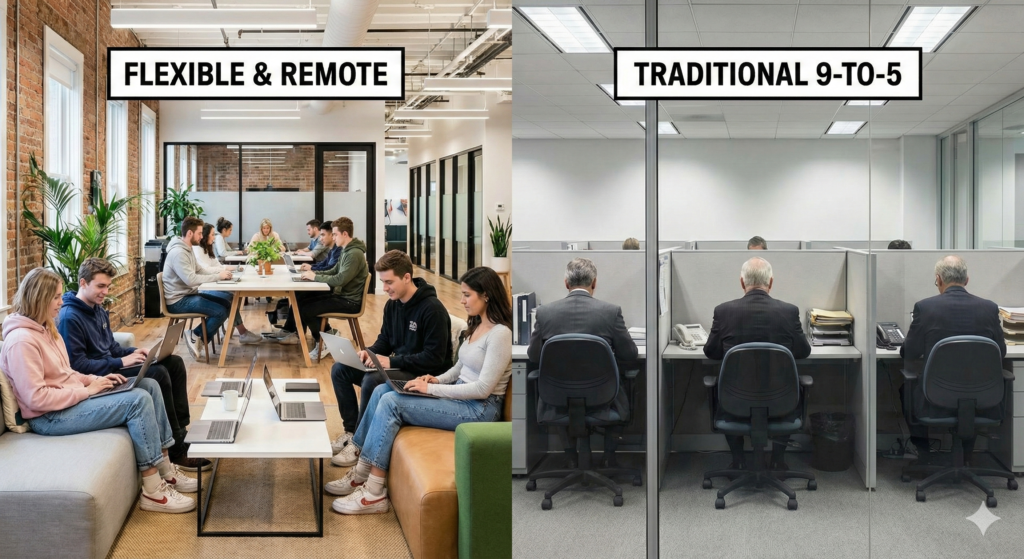
Before and After Covid
But we have long since left behind an era where people said they would do any job and everything progressed at a steady pace. When Generation Z entered the workforce, a generation that grew up with the age of technology, they struggled to adapt to old-fashioned work models. While these issues were being discussed, the COVID-19 pandemic in 2019 accelerated the adoption of remote work as a concept in the work culture.
When it became clear that completely remote work wasn’t a very high-performing approach, the hybrid work model was adopted by many global giants. Now, however, many companies are trying to return to the old-fashioned work system. For the first time in years, so many different work models have been tried by companies in such a short period, and many employees have not wanted to give up their flexibility in the process.
In an era where work environments are changing so rapidly, everyone expected Generation Z to adapt to all these changes immediately. I’m sure you’ve heard about the layoffs in Silicon Valley, but most of these news stories covered the issue superficially to get more clicks. In 2019, Amazon, Microsoft, Google, and Meta hired an average of 90,000 people before COVID, but this number increased to 875,000 after COVID, almost ten times the normal number of hires.
Because people were confined to their homes, there was an unprecedented demand for mobile devices and mobile services. When things returned to normal, demand in this sector began to revert to its previous level. The layoffs currently taking place represent only about 10% of these jobs. Of course, then, with the arrival of ChatGPT, artificial intelligence caused job losses for certain professional groups. Many data-driven jobs can now be done by AI, which is a whole separate podcast topic that we will discuss in detail in another episode.
However, all these rapid hiring and firing events happened to Generation Z. Now I’m sure you’ll ask, are all members of Generation Z angels without wings? Is there nothing this generation has done wrong? Let’s take a look at that.

High technical skills, Low social skills.
According to research, Generation Z has been observed to have significantly lower communication skills compared to all previous generations. However, when compared to previous generations, this generation has achieved much better results in technical skills.
While this generation easily adapts to many new digital tools and technologies, they have failed in communication skills, one of the most important criteria in the workplace. However, I don’t think it would be fair to blame this generation here.
As someone born in 1990, I belong to Generation Y, and it was quite difficult to talk about the existence of technology during the time I grew up. For example, if you liked a girl in high school, you had to run after her and confront her, but now, with some applications, you don’t need to have such a confrontation.
Even before I started elementary school, as the youngest in the family, I was constantly sent to the grocery store and market, and I was constantly in contact with shopkeepers. Now, most parents avoid giving their children such tasks at a young age. Likewise, thanks to some home delivery apps, this has also disappeared.
The worst part of all this is that when I was in elementary school, whenever we went somewhere as a family, my parents would immediately leave me with the other children, and I had to somehow socialise with them. Because hours wouldn’t pass without doing something. But now, even when many children get together, they prefer looking at their phone screens rather than playing physical games, even though they are side by side.
When a generation that can handle everything with mobile devices first stepped into the work environment, we started seeing hundreds of headlines everywhere asking, “What’s wrong with Generation Z?” One of the most striking of these was a study conducted with 1344 managers, revealing that 74% of them had difficulty working with Generation Z.
So what’s the solution?
So how will a generation exposed to so many different changes adapt to the work environment? Instead of constantly saying that Generation Z is problematic or mischievous, let’s take a look at what can be done as a solution.
Prioritising Mental Health in the Workplace: Generation Z wants to work for companies that value their employees’ mental health, are empathetic, and have a healthy work culture. They try to stay away from companies that only care about their employees’ well-being for their own gain.
Respecting Diversity: Generation Z places much greater importance on gender equality than previous generations. They want the companies they work for not to judge their work performance based on their gender, appearance, or clothing.
Growth-Oriented Companies: Generation Z hopes to find bosses and leaders in their workplaces who can guide them and help them develop. They want to work in environments with companies and leaders who show them that they can advance in their field.
Quality Communication: While a large portion of Generation Z seems to prefer communicating via mobile devices, in reality, face-to-face communication is much more genuine for all generations. Instead of sending messages and emails, talking face-to-face, or making a video call instead of a cold email when far away, strengthens personal connections. Prioritising one-on-one meetings whenever possible fosters quality communication and allows employees to feel valued.
Equal pay: Generation Z prefers to work for companies that promise equal pay. Companies that pay the minimum value in the market for recent graduates or employees with a few years of experience, and offer equal benefits to all their staff, have become the primary company profile preferred not only by Generation Z but by all employees.
Final Words
Today’s young employees will be tomorrow’s managers and leaders. Therefore, instead of complaining about Generation Z, companies need to develop new strategies that appeal to their employees and pay attention to their problems and demands. This will only lead to higher-quality work environments and more effective work.
In this episode, we discussed the challenges Generation Z faces in the work culture and how these challenges can be overcome.
I hope I have been able to provide you with useful information. See you in new posts soon, take care and goodbye.
Also Read